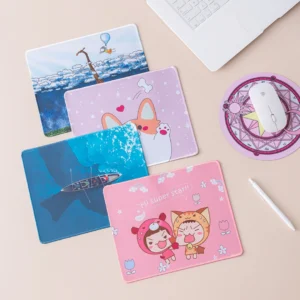
With the popularization of office culture, the development of e-sports industry and the rise of brand customized gift market, mouse pads have developed from simple office accessories to an important carrier for enterprise marketing, brand promotion and e-sports equipment. For wholesalers and enterprise purchasers, choosing a stable and reliable mouse pad factory is an important prerequisite to ensure product quality, timely delivery and customer satisfaction. This paper will analyze how to select stable factories from the aspects of market status analysis, selection criteria, factory inspection process, cooperation mode, risk control and long-term cooperation strategy.
First, the current situation and development trend of the mouse pad market
1.1 global and domestic market size
The mouse pad market is growing steadily worldwide. According to the latest industry data, the global mouse pad market average annual growth rate of about 5%-7% , of which the fastest growing asia-pacific region. The domestic market is also diversifying, driven by office demand, the growth of esports and the need for bespoke gifts:
Office use: Enterprises, government agencies, education units on the mouse pad demand stability and large quantities, mostly custom LOGO or brand-based.
E-sports and games use: with the rapid development of e-sports industry, players and e-sports events for high-performance mouse pad increased demand, such as large size, thick, with RGB lighting e-sports mouse pad.
Creative and gift use: for small and medium-sized enterprises and individual users, emphasizing personalized, shaped design and multi-material combination to meet customized, creative needs.
1.2 characteristics of market competition
The mouse pad market is highly competitive, mainly in the following areas:
(1) price competition
Low-end mouse pad prices between 0.5-2 dollars, mainly for the office, gift market.
High-end e-sports mouse pad prices between $10-30 to high-performance materials, fine technology and brand value as a selling point.
(2) quality competition
Consumers are increasingly demanding the comfort, durability and printing effect of mouse pads.
The color brilliance, edge edge sealing quality and dimensional accuracy of customized mouse pads have become key indicators.
(3) service competition
Factory delivery, after-sales service and customization flexibility directly affect the willingness of wholesalers to cooperate.
During holidays or rush season, supply stability becomes an important consideration when choosing a factory.
Through the above analysis can be seen, wholesalers choose the mouse pad factory can not only rely on price, but also need to consider the quality, capacity, service and customization.
Second, select the key criteria for stable factory
Stable factory means not only reliable product quality, timely delivery, but also in the long-term cooperation to meet customized needs, technological upgrading and market changes. Key criteria for selecting a factory include:
2.1 product quality control
(1) selection of raw materials
High-quality mouse pad materials usually include natural rubber, TPR (thermoplastic rubber) , Pu, cloth or micro-fiber, etc. .
Materials affect the feel of the mouse pad, wear resistance and stability, poor-quality materials easily deformation, hair or smell.
(2) technological level
Edge sealing: the factory will use precision sewing or hot edge sealing technology to prevent the use of the mouse pad off the edge.
Printing effect: digital printing or screen printing to ensure that the pattern of bright colors, wear-resistant water.
Dimensional accuracy: production dimensional error within ± 1 mm, to ensure the consistency of mass production.
(3) quality inspection process
Excellent factory generally has incoming inspection, production inspection, shipment sampling and other complete quality inspection system.
The test items include material thickness, printing color difference, edge fastness, repeated use wear resistance and so on.
2.2 production capacity and delivery stability
(1) capacity scale
A large, stable facility with multiple production lines that can handle large orders and avoid temporary shortages.
Small factories may not be able to meet bulk demand during peak order times and are prone to late deliveries.
(2) production cycle time and rush capacity
Understand the factory’s average production cycle time and special order processing capacity, especially during holidays and sales promotion season.
(3) inventory management
Some factories will provide regular inventory service, to facilitate the rapid delivery of small batch orders, improve supply chain response speed.
2.3 customizability and flexibility
Wholesalers often need custom mouse pads, but stable factories should have:
Pattern Printing: support full-color printing, photo-level effects, corporate LOGO customization.
Special-shaped cutting: according to customer needs to produce special-shaped mouse pad, such as animal shapes, brand shapes.
Multi-material combination: support cloth, Pu, silicone, LED and other multi-material combination, to meet the functional and aesthetic needs.
Packaging customization: provide gift box, separate packaging or enterprise custom packaging, enhance the added value of products.
2.4 corporate qualifications and reputation
(1) business license and production qualification
Formal factories need to have industrial and commercial registration, tax registration and production license.
(2) industry certification
ISO9001 quality management system certification, SGS, CE and other product testing certification is an important reference.
(3) customer case and market reputation
The factory stability and market recognition are judged by customer list, cooperation case and online evaluation.
Visit the specific process of the factory
You Can’t just look at the promotional materials when choosing a factory. You need to do a lot of validation.
3.1 preliminary screening online
(1) information collection
Using Alibaba and other business-to-business platforms to obtain factory information.
(2) qualification audit
Verify business licenses, production permits, and certifications to ensure legitimate operations.
(3) sample acquisition
Samples were obtained and tested for texture, feel, printability, and abrasion resistance.
Compare samples from different factories to evaluate cost performance and product consistency.
3.2 site visits
(1) production workshop
Check the number of equipment on the production line, process level, operating environment and safety measures.
(2) raw material warehouse
Confirm the storage and source of raw materials to ensure the stability of supply.
(3) quality inspection
To observe whether the quality inspection process is perfect, there are special quality inspection personnel and testing equipment.
(4) employee stability
Factories with high employee stability have smoother production processes and more reliable product quality.
3.3 sample and trial order testing
Small batch test order: test the production speed, packing quality and delivery accuracy of the factory.
Long-term observation: record the problems in the test order and the efficiency of solving them, judge the service ability of the factory.
Market feedback: put samples on the market, collect customer feedback, evaluate the reliability of factory products.
Cooperation mode and risk control
4.1 cooperation
(1) OEM model
The wholesaler provides the design solution and the factory produces the finished product, which is suitable for the existing brand enterprises.
(2) ODM model (factory design and production)
The factory provides design and production solutions for wholesalers who want products to be put on the shelves quickly.
(3) long-term agreements
Sign annual supply contract to ensure stable price, delivery and quality.
4.2 risk management
(1) risk of price volatility
Lock in prices through annual contracts to avoid cost fluctuations due to rising raw material costs.
(2) quality risk
Clarify quality inspection standards and return and exchange provisions, and introduce third-party testing to ensure quality.
(3) delivery risk
Make delivery dates and liability for breach of contract clear in the contract to ensure the stability of the supply chain.
(4) alternative suppliers
Maintain 1-2 back-up plants in case of unexpected problems with the main supplier.
Long-term strategy
Build Trust
Through transparent communication, regular return visits, technical support and other ways to enhance cooperation and trust.
Jointly develop new products
Work with factories to develop new mouse pads to improve market competitiveness and differentiation advantage.
Optimize purchasing process
Plan orders and logistics in advance to reduce the risk of emergency replenishment.
Quality data sharing
Share customer feedback and market data to help factories optimize production and design.
Rational distribution of profits
We should ensure reasonable profits for both sides and improve the stickiness and long-term stability of cooperation.
Vi. Practical suggestions and case studies
6.1 practical advice
Establish evaluation form: list price, material, process, production capacity, delivery, quality inspection, customizing ability, qualification and reputation, etc. .
Long-term test order: different batches of small orders, testing consistency and service responsiveness.
Market verification: put the mouse pad into the target market, collect feedback and judge the product adaptability.
6.2 case studies
(1) Case Study 1: Office Mouse Pad wholesaler
Through on-line screening and site visits, we selected a factory with 3 automated production lines and ISO9001 certification.
Trial orders and market feedback shows that the product thickness uniformity, printing color stability, Edge not off line, long-term orders successfully completed.
(2) Case 2: Esports Mouse Pad brand
The factory has the ability of special-shaped cutting and RGB lighting effect integration.
After small batch test order found packaging and transport vulnerability problems, through the adjustment of packaging design to solve, to achieve stable supply.
Conclusion
The wholesale mouse pad chooses the stable factory, is guarantees the source of goods to be stable, the product quality reliable and the customer satisfaction promotion core link. Select the factory to consider the quality, production capacity, customization ability, enterprise qualification and reputation, and through sample testing, site visits, trial orders to verify stability. In the long-term cooperation, the establishment of trust mechanism, joint research and development of new products, optimization of procurement process and risk control strategy, can achieve a win-win situation between wholesalers and factories. In the future, with the mouse pad market to personalized and high-performance development, stable, reliable, flexible factory will become the key wholesalers to win the market resources.